
The Pickleball Warm Up Routine We Give Players Over 40
October 12, 2026 · Dr. Luis Montes, DPT, Founder of Kiva InMotion

You booked the court for 8 a.m. You get there at 7:58, hit a few dinks, and you're straight into a game. By the third point you're lunging for a ball at the kitchen line and your hip feels tight and your shoulder feels a step behind.
Most players over 40 know they should warm up. Few know what a good warm-up for pickleball looks like, so they skip it or stand at the fence holding a hamstring stretch. This is the pickleball warm up routine we give our own players at Kiva InMotion. It takes about 10 minutes and needs one resistance band. It's built around how the game actually moves.
Why your warm-up matters more now
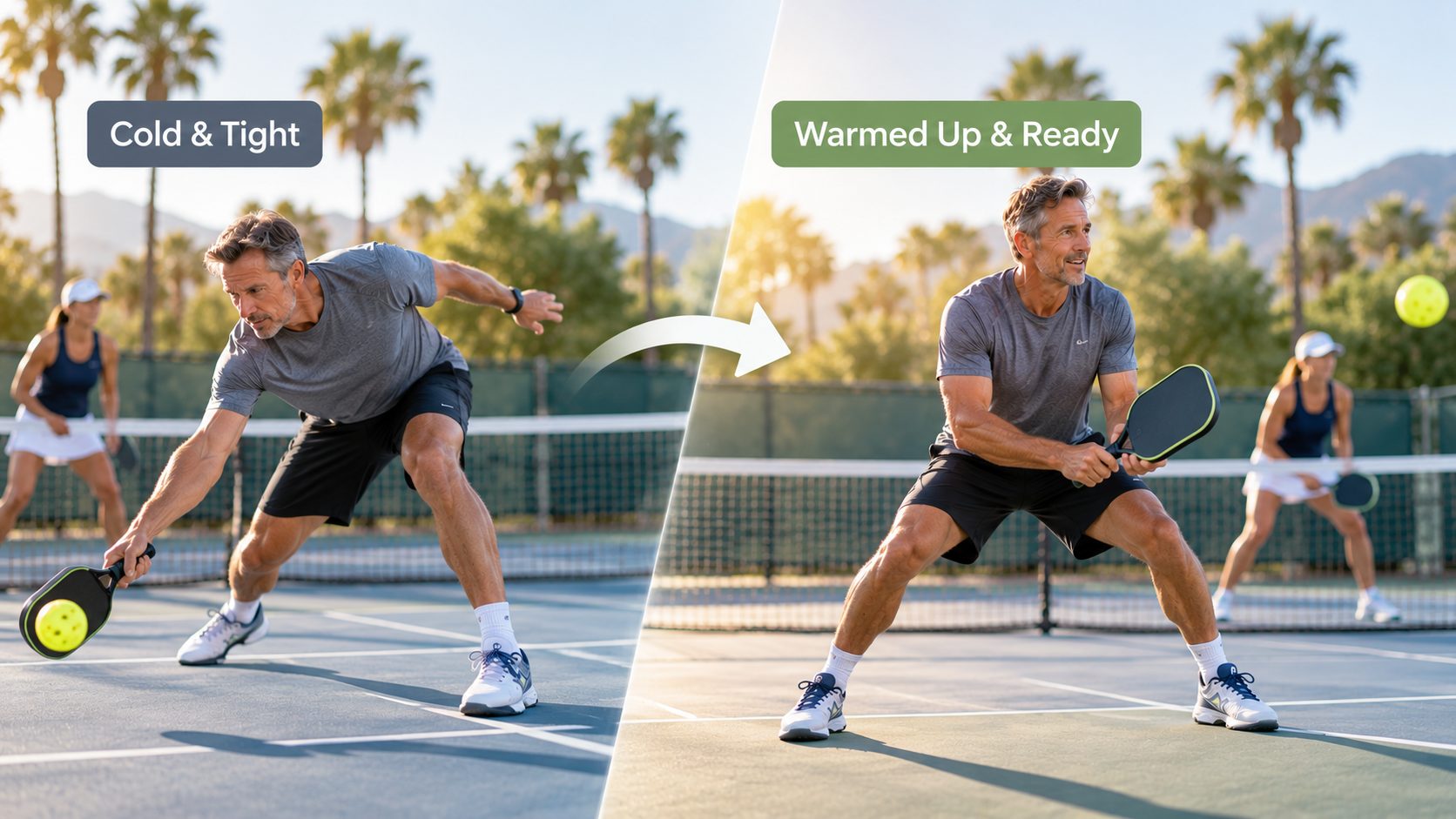
At 25 you could walk onto the court cold and feel fine by the second game. At 45 or 55, your joints and muscles usually need more time to get ready for quick starts, low lunges and overhead swings. That doesn't mean anything is wrong with you. It means the first ten minutes of your session do more of the work than they used to.
Pickleball looks gentle from the sidelines, but it asks a lot. You split-step, shuffle sideways, drop low for dinks, reach overhead and change direction over and over. A good warm-up gets each of those movements ready before the game asks for them.
Two parts: mobility, then activation
A good warm-up has two parts, and the order matters. Dr. Luis Montes, our founder, puts it plainly:
"A warm-up for a 50-year-old player should be at least 5 minutes, optimally 10 minutes. It should include dynamic stretching and dynamic movements, not passive stretching."
Dr. Luis Montes, DPT, Founder of Kiva InMotion
Part one is dynamic mobility. You take the shoulders, hips, knees and ankles through their full range of motion while you keep moving. No resistance and no long holds.
Part two is activation. You wake up the specific muscles that keep those joints steady during play: the rotator cuff and shoulder blade muscles, the glutes (including the gluteus medius on the side of your hip), the quads, the hamstrings, the calves and your core.
Mobility gets the joints moving. Activation gets the muscles around them ready to work.
What to skip: long static holds
The classic warm-up of holding a stretch for 30 to 45 seconds isn't what we recommend before you play. Those long holds have their place, usually after a session or on a separate mobility day. Before a game you want your body warm and moving, not just loose. Save the long stretches for later.
Part one: dynamic mobility (about 4 to 5 minutes)
Move smoothly and stay in a range that feels comfortable. Go a little bigger with each rep.
Shoulders
- Arm circles, small to large, forward and backward. About 10 each way.
- Cross-body arm swings, opening wide and then hugging across your chest. About 10.
- Overhead reaches, alternating arms, as if you're reaching for a lob. About 10 per side.
Hips
- Front-to-back leg swings, holding the fence or net post for balance. About 10 per leg.
- Side-to-side leg swings across your body. About 10 per leg.
- Walking knee hugs, pulling one knee toward your chest as you step forward. About 5 per leg.
Knees and ankles
- Slow bodyweight knee bends, going a little deeper each time. About 10.
- Ankle circles and heel-to-toe rocks. About 10 each direction per ankle.
Shoulders, hips and knees matter most here. If you're short on time, don't skip them.
Part two: activation (about 5 minutes)
This is where the band comes in. A light loop or long band is enough, and it fits in your paddle bag.
Shoulder activation. Your rotator cuff and shoulder blade muscles keep the shoulder steady while you swing.
- Band external rotation: elbow at your side and bent to 90 degrees, rotate your forearm outward against the band. 10 to 12 per arm.
- Band internal rotation: same position, rotate inward. 10 to 12 per arm.
- Band rows: anchor the band on the fence, pull your elbows back and squeeze your shoulder blades together. 10 to 12.
Glute and hip activation
- Bridges: lie on your back with knees bent and lift your hips. Do 10 two-leg bridges, or 6 to 8 single-leg bridges per side if those feel good. A mat or towel works fine.
- Band side steps: wrap the band around your knees or ankles, sit back slightly and step sideways. About 10 steps each direction. You should feel this on the outside of your hip, where the gluteus medius helps steady you on lateral shuffles.
Lunges in every direction. This is the most pickleball-specific part of the routine. Do forward lunges, side lunges and diagonal lunges, 3 to 4 per direction per leg. The game pulls you in all of those directions, so warm up all of them.
Air squats. 10 light, controlled squats to get the glutes, quads and hamstrings working together.
Calves and ankles
- Pogo hops: small, gentle bounces on the balls of your feet. About 15 to 20.
- Jump squats: five or six is plenty. You don't need more than that.
Core
- Plank: 30 to 45 seconds. Keep it easy. The goal is to switch the core on, not tire it out.
The full 10-minute routine at a glance
- Arm circles, cross-body swings, overhead reaches
- Leg swings front-to-back and side-to-side, walking knee hugs
- Knee bends and ankle circles
- Band external and internal rotation, band rows
- Bridges (two-leg or single-leg)
- Band side steps
- Lunges: forward, side, diagonal
- Air squats
- Pogo hops, then 5 or 6 jump squats
- Plank, 30 to 45 seconds
Then pick up your paddle and start with easy dinks before you play points.
Morning games vs. afternoon games
When you play changes what to focus on.
Morning: Your joints have been still all night. Spend more of your time on mobility and a bit less on activation. If you're short on time, do the whole mobility section and keep only the shoulder band work and a few lunges.
Afternoon or evening: You've been moving all day, so blood has been flowing through your joints for hours. Do a shorter mobility round and put more time into activating the shoulders, hips and ankles.
When a warm-up isn't enough
A good warm-up helps you feel ready. It can't tell you why one shoulder always feels tight on overheads or why one hip feels off on wide balls. Those patterns usually come down to a few specific things your body needs, and you shouldn't have to guess what they are.
That's the work we do in Precision Mobility. We look at how you move, find the few things that matter most for your game, and give you a short plan built around them. If you want to keep playing the game you love with fewer surprises, book a Precision Mobility session with our team.
Frequently asked questions
How long should a pickleball warm-up be for someone over 40?
At least 5 minutes, and ideally about 10. That's enough to take your shoulders, hips, knees and ankles through their full range and then activate the muscles that support them. If you only have 5 minutes, focus on dynamic mobility for your shoulders and hips.
Should I stretch before playing pickleball?
Yes, but use dynamic stretches, not long static holds. Leg swings, arm circles and lunges get your joints moving and ready to play. Save the 30- to 45-second holds for after your session or for a separate mobility day.
Do I need equipment for this warm-up?
Just one light resistance band. It's especially useful for the shoulder exercises (external rotation, internal rotation and rows) and for side steps. Everything else uses your body weight, and a towel or mat is enough for bridges and the plank.
Is my warm-up different for a morning game?
Yes. In the morning, put more time into mobility and less into activation, because your joints have been still overnight. In the afternoon or evening, you've been moving all day, so you can do less mobility and focus more on activating your shoulders, hips and ankles.
What if something still feels tight or uncomfortable after I warm up?
A warm-up is general preparation and can't sort out a specific issue. If the same area keeps bothering you on the court, have it looked at by a qualified professional. An assessment can show what that part of your body needs so you can keep playing with confidence.
About the author
Dr. Luis Montes, DPT, is the founder of Kiva InMotion and a physical therapist with nearly 25 years of orthopedic and sports medicine experience, helping active adults stay strong on the court, the course and the trail.
Read more about Dr. Montes