Pickleball Knee Pain and Tight Calves: Why the Lower Leg Takes the Hit After 50
October 26, 2026 · Dr. Luis Montes, DPT, Founder of Kiva InMotion
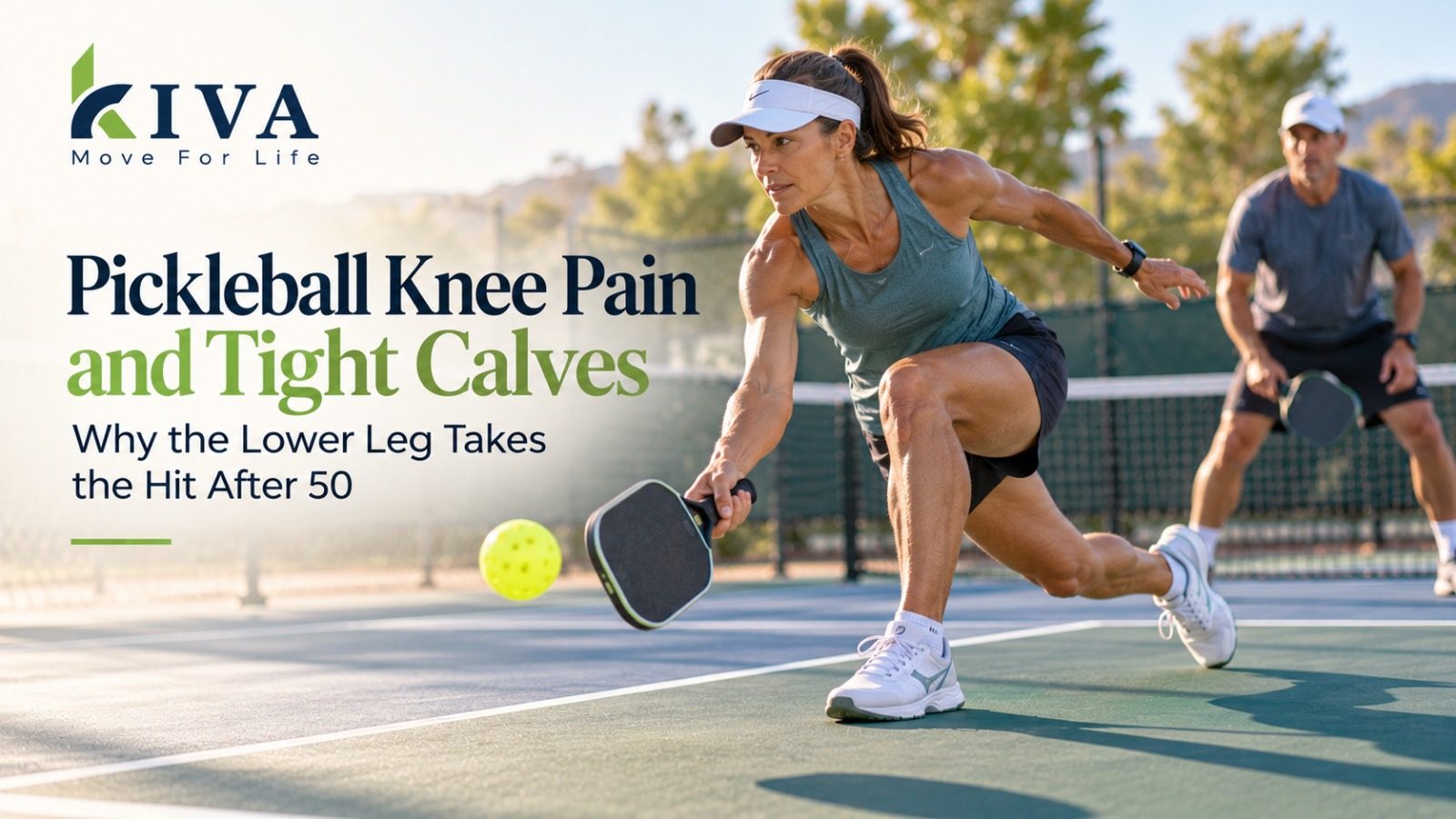
Pickleball knee pain usually starts quietly. You notice a dull ache after the third game, or some stiffness when you stand up from the car after league night. It goes away by Wednesday, so you play again on Thursday. Then indoor season starts. You're playing four or five times a week instead of two, on a gym floor that grabs your shoes, and the ache stops going away between sessions.
If that sounds familiar, the knee may not be the whole story. In my practice, the lower leg is almost always part of the conversation when someone comes in with knee pain from pickleball. The calf, the Achilles and a small muscle on the front of your shin all affect how much load reaches the knee every time you stop, start and change direction.
This post covers why that happens, what we look at first, a few exercises that tend to surprise people, and how to pick a court shoe that helps instead of hurts.
Why pickleball is hard on the knee
Pickleball looks gentle from the bleachers. The court is small, the ball is slow and nobody is sprinting the length of a tennis court. That's exactly why it fools people.
The game is built on short bursts. You split-step, lunge for a dink, recover, shuffle sideways, then jump back for a lob. Every one of those moves asks your legs to absorb your body weight and redirect it, often in less than a second. Most of the stress isn't in the speed. It's in the stopping.
When you stop quickly, something has to slow your body down. Ideally that work is shared across the hips, thighs, calves, ankles and feet. When one link in that chain is tight, weak or tired, the knee tends to pick up the slack. The knee is a fairly simple hinge sitting between two complicated areas, the hip and the ankle, so it often ends up paying for problems that started somewhere else.
More knee complaints than calf complaints (and why that can be misleading)
People come in talking about their knees far more often than their calves. That makes sense. The knee is where you feel it.
But the calf is closely tied to the knee. As I explained when we talked through this topic:
"The calf is a muscle that crosses the knee joint. You have the gastrocnemius muscle, which crosses the knee joint, and then you also have the soleus muscle. That particular muscle doesn't cross the knee joint, but it can also get tight."
Here's the plain-English version:
- Gastrocnemius. The bigger, visible calf muscle. It starts above the back of the knee and runs down into the Achilles tendon. Because it crosses the knee, tightness here can change how the knee moves and how it handles load.
- Soleus. A deeper, flatter muscle underneath. It starts below the knee, so it doesn't cross the joint, but it does a huge amount of the work when you're on the balls of your feet in a ready position, which is most of a pickleball rally.
Together they're often called the gastrocnemius complex, or just "the calf." Two separate muscles, two separate jobs, and they need to be trained differently. When either one is tight or runs out of endurance, your ankle doesn't bend as freely as it should. When the ankle can't bend, the knee often moves more, or in a different direction, to make up for it.
So someone may walk in saying "my knee hurts," and the plan still spends real time on the calf. That isn't a detour. It's often the main event.
What a knee plan actually includes
Every person is different, and a good assessment should come before any specific program. Still, there are patterns we see over and over with active adults who play pickleball. Here's what tends to show up.
Strengthening the calf, both muscles
For almost every client with knee pain, part of the work addresses the calf. That may be strengthening, stretching or both.
The key detail is knee position:
For the gastrocnemius: a heel raise with your knee straight. Stand near a wall or counter for balance, rise up onto the balls of your feet, pause, and lower slowly. The slow lowering matters as much as the lift, because that's the same kind of work your calf does when you put on the brakes during a point.
For the soleus: a heel raise with your knee bent. Bend your knees a bit, as if you were in a ready position at the kitchen line, and do the same raise. Bending the knee takes much of the gastrocnemius out of the movement, so the soleus does most of the work.
Most people only ever do the straight-knee version, if they do calf work at all. The bent-knee version is the one that tends to feel unfamiliar, and for pickleball players it's often the one that matters most.
Stretching the right muscle
Sometimes the issue isn't strength. One of those muscles is simply tight. The stretch changes depending on which one:
Gastrocnemius stretch: stand facing a wall, one foot back, back knee straight and heel on the floor. Lean forward until you feel a stretch high in the calf.
Soleus stretch: same setup, but bend the back knee while keeping that heel down. You'll feel the stretch move lower, closer to the Achilles.
Hold each for about 30 seconds and breathe. A stretch should feel like a stretch, not sharp pain.
The muscle nobody thinks about: tibialis anterior
This is the part that surprises people. For knee pain, I often recommend strengthening the tibialis anterior, the muscle along the front of your shin.
It doesn't get much attention. Nobody can really see it, and nobody is posting photos of it. But it plays a big role in deceleration. When you run quickly forward and back, as you do constantly in pickleball, this muscle fires to help slow the forward momentum of your body. If it's weak or tires early, more of that braking force travels up the leg toward the knee.
A simple way to start: stand with your back and hips against a wall, feet about a foot out in front of you. Keep your heels on the floor and lift your toes toward your shins, then lower them slowly. Start with a set of 10 to 15 and build from there. It burns more than people expect.
The court shoe question
One mistake I see all the time: someone feels like their shoes are heavy, so they switch to the lightest pair they can find. Lighter shoes feel quick for the first week. But many of them don't give you the stability you need. Here's how I put it:
"You've got to find the right balance between a shoe that is going to be comfortable and light enough for you to be able to move around, but at the same time give you that stability, especially for those lateral movements and quick forward and back movements that you have in pickleball."
Dr. Luis Montes, DPT
Here's what to look for when you're shopping.
Choose a court shoe, not a running shoe
Running shoes are designed for forward motion. Many have a soft, tall heel and a narrow base, which is great on a road and less helpful when you're shuffling sideways at the kitchen line. Court shoes (pickleball, tennis or indoor court models) are built with a wider base and firmer sides so your foot stays over the sole when you change direction. If you're still playing in running shoes, this is usually the first change worth making.
Check the lateral support
Hold the shoe and try to roll the upper over the side of the sole. A good court shoe resists. Look for reinforcement along the sides of the forefoot and a heel counter (the back of the shoe) that feels firm when you squeeze it. That structure is what keeps your ankle from rolling during a quick sideways stop.
Match the outsole to where you play
This matters more in indoor season. Indoor gym floors and outdoor hard courts behave differently.
- Indoor: a gum rubber or non-marking outsole made for indoor courts gives you grip without leaving marks. Some indoor floors are very grippy, though, so a sole that's too sticky can hold your foot in place while your knee keeps turning. Pay attention to how your knees feel after your first few indoor sessions.
- Outdoor: a tougher outsole, often with a herringbone or modified herringbone tread, holds up better on asphalt and concrete.
If you play both, consider a pair for each. It also helps the shoes last.
Don't chase weight alone
A lighter shoe is nice, but weight is only one feature. A shoe that's a little heavier and keeps you stable through a lateral lunge is a better trade than a featherweight shoe that lets your foot slide around inside it.
Fit and replacement
Try shoes on later in the day, when your feet are a bit bigger, and wear the socks you actually play in. You want a thumb's width at the toe and no heel slipping. Check the tread regularly. Once the pattern is worn smooth in the forefoot, where you push off and pivot, the shoe has lost much of its grip and support, even if the upper still looks fine.
Shoes won't solve knee pain by themselves. But the wrong shoe can make every other part of the plan harder.
When your calves keep cramping
If you get calf cramps often during or after play, look into it. Don't just stretch on the sideline and keep going.
There are a few common reasons:
- The gastrocnemius is tight. Stretching it regularly, with the straight-knee stretch above, may help.
- The calf doesn't have the endurance for how you're playing. This is common when indoor season bumps you from two sessions a week to five. The muscle may be strong enough for a game, but not for three hours of open play. The answer is gradual endurance work, like higher-rep heel raises in both knee positions, plus a slower build in how much you play.
- Nutrition and electrolytes. Cramps can also be linked to deficiencies in nutrition, especially electrolytes. If you're cramping a lot, it's worth talking to your physician about hydration, diet and any medications that might play a role.
Frequent cramping is your body giving you information. It's worth listening to.
When to get it looked at
Some knee soreness after a busy week of play is common. But get a proper evaluation from a licensed clinician if you notice:
- Swelling that shows up after play and doesn't settle within a day or two
- A knee that locks, catches or gives way
- Pain that wakes you up at night
- Pain that's been changing how you walk, climb stairs or play for more than a couple of weeks
- Sudden sharp pain in the back of the heel or calf during play
Those signs need a diagnosis, not a stretching routine.
You don't have to guess
Most people with pickleball knee pain don't need a 30-exercise program. They need to know which few things their body actually needs. Is it the gastrocnemius, the soleus, the tibialis anterior, the shoes, the jump from two days a week to five, or some mix? Guessing tends to lead to doing a little of everything and not enough of the right thing.
That's the work we do at Kiva InMotion. We look at how you move, figure out where the load is going, and build a short, specific plan so you can keep playing the game you love. If you're ready to stop guessing, work with a Kiva InMotion coach and we'll start with what your knees, calves and ankles are telling us.
You can also learn more about how Kiva InMotion approaches Precision Mobility for active adults.
Frequently asked questions
Can tight calves really cause knee pain in pickleball?
They can contribute to it. The gastrocnemius crosses the back of the knee, and when the calf muscles are tight, your ankle may not bend as freely. The knee often makes up for that limited motion, which can add stress during the quick stops and lunges pickleball demands. That's why calf work is part of most knee plans we build at Kiva InMotion.
What's the difference between a straight-knee and bent-knee heel raise?
A straight-knee heel raise works mostly the gastrocnemius, the larger calf muscle. A bent-knee heel raise takes much of the gastrocnemius out of the movement so the soleus, the deeper calf muscle, does most of the work. Pickleball players spend a lot of time on the balls of their feet with knees bent, so the bent-knee version is especially useful.
Are lighter pickleball shoes better for my knees?
Not necessarily. Very light shoes can feel quick but often give up lateral support. Look for a court-specific shoe with a wide base, firm sides and a supportive heel, with an outsole made for the surface you play on. Comfort and stability matter more than shaving a few ounces.
Why do my calves cramp during long pickleball sessions?
Common reasons include a tight gastrocnemius, a calf that doesn't yet have the endurance for how much you're playing, or nutrition and electrolyte issues. Regular stretching, gradual endurance work and a talk with your physician about hydration and diet are good places to start. Frequent cramping is worth looking into.
When should I see someone about pickleball knee pain?
See a licensed clinician if you have swelling that doesn't settle in a day or two, a knee that locks or gives way, pain at night, sudden sharp pain in the back of the heel or calf, or pain that has changed how you move for more than a couple of weeks.
About the author
Dr. Luis Montes, DPT, is the founder of Kiva InMotion and a physical therapist with nearly 25 years of orthopedic and sports medicine experience, helping active adults stay strong on the court, the course and the trail.
Read more about Dr. Montes